RC Snowcat – Custom 3D Printed Tracked Vehicle (V1 Prototype)
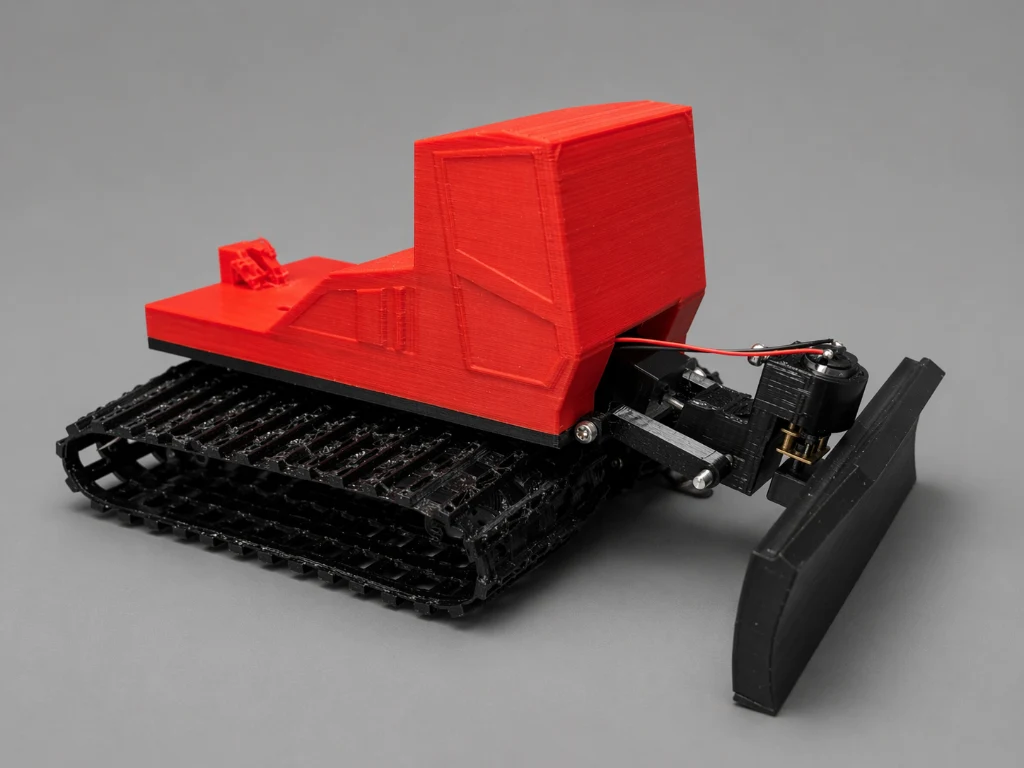
RC Snowcat – Custom 3D Printed Tracked Vehicle (V1 Prototype)
Project Overview
The goal of this project was to design and build a fully functional, compact RC snowcat optimized for real-world performance in snow—not just appearance. While scale accuracy wasn't the top priority, the target size was roughly 1/24 scale (SCX24-sized platform) to keep it small, lightweight, and maneuverable.
From the beginning, this build focused on functionality, control, and deep-snow capability, while still maintaining a unique, futuristic design.
Core Design Requirements
- Roughly 1/24 scale footprint (~100mm body length)
- Powered by N20 geared motors
- Tank steering (independent track control)
- Functional front blade with:
- Up/down motion
- Left/right angle control (dual-axis)
- Designed to perform well in deep snow
- Fully custom electronics, including:
- Custom PCB (KiCad)
- Wireless control via Xbox controller (BluePad32)
Mechanical Design
Tracked Drivetrain
The snowcat uses two N20 motors per track, giving it enough torque to move through snow while maintaining a compact size.
A major challenge was track geometry:
- Early versions had narrow tracks and wide body → poor performance
- Final design prioritizes:
- Wider tracks = better floatation
- Narrow track spacing = less high-centering
To achieve this, the motors are mounted inside the tracks themselves, which was a key breakthrough in the design.
Blade System (2-Axis Control)
One of the main differentiators of this build is the fully functional blade:
- Vertical movement (up/down):
- Custom-built linear actuator
- Uses a threaded N20 motor
- Designed because no off-the-shelf actuator was small enough
- Horizontal steering (left/right):
- Direct-drive N20 motor
- Simple, strong, and compact solution
This dual-axis blade was important because most small builds only include vertical movement, which limits real usability.
Electronics & Control System
Custom PCB (KiCad)
Instead of using off-the-shelf RC electronics, this build uses a fully custom-designed PCB:
- Acts as a compact control hub
- Designed to minimize size while handling:
- Motor control
- Power regulation
- Microcontroller integration
Surprisingly, the PCB worked first try, despite being a complex part of the project.
Microcontroller & Input
- Uses a Seeed Studio microcontroller (XIAO series)
- Chosen for:
- Extremely small size
- Enough performance for real-time control
Control is handled through:
- BluePad32 (Bluetooth controller library)
- Allows connection to:
- Xbox controllers
- PlayStation controllers
- Allows connection to:
This gives the snowcat a much more intuitive and modern control system compared to traditional RC transmitters.
Motor Control & Power
- Two 5V motor drivers control the tracks (PWM-based forward/reverse)
- Enables:
- Smooth throttle control
- Tank steering
- Enables:
- Powered by:
- 3.7V battery
- 5V boost converter for stable electronics power
- Includes decoupling (coupling) capacitors:
- Help reduce electrical noise from motors
- Improve system stability
Design & Aesthetics
The exterior design was inspired by real snowcats but intentionally not a direct replica.
Goals:
- Futuristic, angular look
- Clean geometric shapes
- Functional packaging (must fit PCB and components)
The result is a design that balances:
- Functionality
- Manufacturability (3D printing)
- Unique visual identity
Development & Iteration
This project involved heavy iteration, especially on mechanical components:
- Frame: ~10 iterations
- Tracks: ~3 major redesigns
- Blade system: multiple refinements
- Electronics: surprisingly successful on first PCB revision
Everything was:
- Designed in SolidWorks
- Prototyped on a home 3D printer
- Built entirely from scratch (no borrowed designs)
Challenges & Key Learnings
- Packaging is everything at this scale
- Track geometry has a huge impact on snow performance
- Off-the-shelf parts don't always exist → sometimes you must design your own (linear actuator)
- Custom electronics drastically improve integration, but increase complexity
- Iteration is unavoidable—especially for moving mechanical systems
Current Status (V1 Prototype)
This is a fully functional Version 1 prototype:
- Drives reliably
- Blade operates in both axes
- Wireless controller works
- Performs significantly better in snow than early versions
However, there's still room for improvement:
- Refining durability
- Improving track efficiency
- Cleaning up wiring and packaging
- Further optimizing weight and balance